One-click package
Show me content for:
Before you start:
- Download and install the latest version of Viewer on the computer where you are going to run the configuration process.
- If you already have Host installed and running on the Viewer PC — stop Host (right click on the Host tray icon and select Stop Host).
Where to Use
Use the "One-Click" configuration option to build an easy-to-install Host package. The output .exe file is a self-extracting Host installer with your custom settings. A remote user will only need to run the file to install Host on their computer.
Sample Goals
For the purposes of this tutorial, we will assume you have the following goals:
- Goal 1 Enable Internet-ID connection on Host.
- Goal 2 Configure Host to send the Internet-ID access credentials to you via email.
- Goal 3 Enable notification panel.
- Goal 4 Protect Host settings with a password.
- Goal 1 Generate an Internet-ID code and have it sent to you via email.
- Goal 2 Use the default (public) Internet-ID server.
- Goal 3 Also generate a unique access password for each Host and send it encrypted via email.
- Goal 4 Disable asking for confirmation to install Host.
- Goal 5 Enable notification panel.
- Goal 6 Protect Host settings with a password.
Let’s see how you can configure the Host installer to achieve these goals.
Configuration process
Run Viewer as an administrator and select Tools ➝ MSI Configurator:
Step 1: Specify how the configuration process should proceed
Select Online configurator and click Next:
Important!
In this tutorial we select Online configurator at step 1. With this option your choices are uploaded to our server and a final output file is downloaded. The output file is signed with our digital signature. The Online configurator option is recommended in most cases.
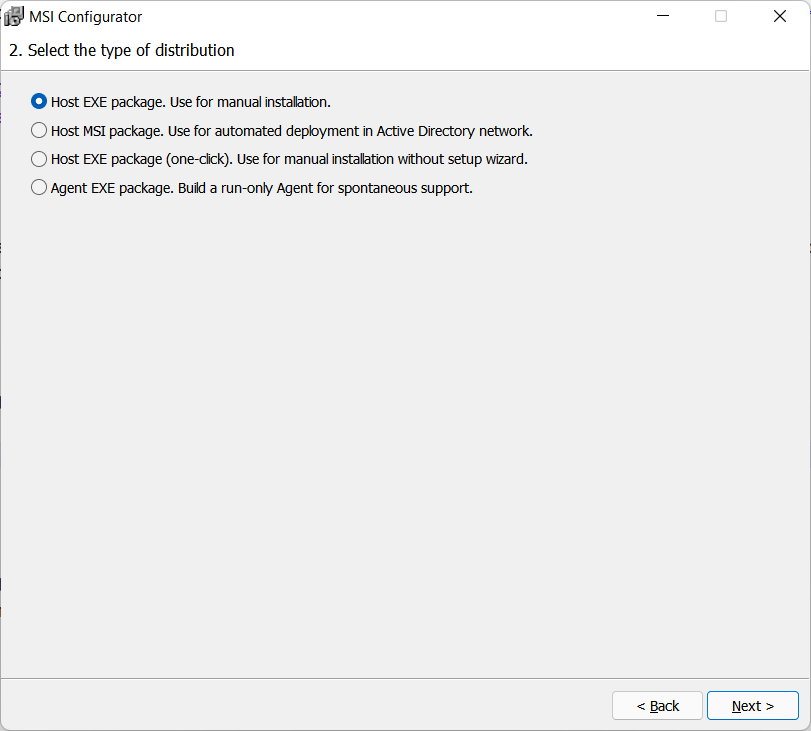
Step 2: Select the type of distribution
Select One-Click package and click Next.
Step 3: Advanced options
"Internet-ID" tab
On the "Internet-ID" tab do the following:
- Select the following checkboxes (Goal 1):
- Set or update Internet-ID connection settings
- Generate a new Internet-ID code
- Send Internet-ID to email
- Select Automatically generate Host password. Each Host will have a unique randomly generated access password.
- Select Use default (public) Internet-ID server. Each Host will use our company's Internet-ID server in the cloud to broker a remote connection.
Configuring SMTP
In this example we'll be using a free Gmail account without two-factor authentication. Adding SMTP server information will let Hosts send emails with access credentials to the email address that you specify (Goal 2).
Important!
If your email account uses 2-factor authentication, you will need to create an "application password". Please, refer to your account documentation for more information. Example: How to sign in using app passwords in Gmail.
- Click Configure SMTP...:
- Enter your SMTP server account details and access credentials. Modify the message template if necessary and click Send test email:
- If you entered your email account credentials correctly, a "successful" message will appear:
- You should receive a test message to your "Destination email" address:
- In the Configure SMTP window click OK. Read the disclaimer message and click Yes if you agree (and No if you do not agree):
- Click Next to proceed to the next configuration step:
On the Internet ID tab do the following:
- Enable Set or update Internet-ID connection settings
- Enable Generate a new Internet-ID code and Send Internet-ID to email.
- Specify your email address (Goal 1).
- Select Automatically generate Host password (Goal 3).
- Select Use default (public) Internet-ID server(Goal 2).
Important!
For information on the options available in this tab please refer to this page.
"Other" tab
Switch to the Other tab and enable Do not ask for confirmation (Goal 4). Click Next.
Step 4: Settings update
Select Pre-configure and enable General and network settings. Click Finish:
The Host configuration window will open:
Enable Show notification panel (Goal 3):
Navigate to Settings protection:
Select Password protect settings. Enter and confirm settings protection password (Goal 4). Click OK and close the settings protection window:
Click OK to close Host settings configuration window:
The configuration process will begin:
At the end of the configuration process the output file will download:
You will be prompted to save the output file. Choose a destination and click Save:
Configuration has been finished successfully. Click OK to close the configuration window.
Select Pre-configure Host settings and click Finish:
The Host settings window will open:
Click Settings for Host and select Options:
In the Options window select Show notification panel (Goal 5). Click OK:
Click Settings for Host and select Settings protection:
In the Settings protection window enable Password protect settings. Enter and confirm settings protection password. Click OK and close the settings protection window:
Close the Settings window by clicking the X button at the top-right corner of the window:
The configuration process will begin:
At the end of the configuration process the output file will download:
You will be prompted to save the output file. Choose a destination and click Save:
Configuration has been finished successfully. Click OK to close the configuration window.
Installing Host
This is how to install Host from the configured package:
Copy the file onto the target computer and double click the file to run it:
In the User Account Control (UAC) prompt click Yes:
You will be prompted if you want to proceed with the installation. Click Yes:
Important!
To disable this message you can select Do not ask for confirmation before installation in Step 3 of the configuration wizard.
The installation process will begin in the background. Once it is finished, the Host icon will appear in the system tray on the remote computer:
Copy the file onto the target computer and double click the file to run it:
In the User Account Control (UAC) prompt click Yes. If you used the Online Configurator option at Step 1 of the configuration process, the file should be listed as a digitally signed file coming from "Remote Utilities LLC":
The installation process will begin in the background. Once it is finished, the Host icon will appear in the system tray. The blue dot on the icon means that Host has successfully connected to an intermediary Internet-ID server:
Connecting to the remote PC
During Host configuration you instructed the program to use your SMTP server for sending the Internet-ID code and a randomly generated access password to your email address.
Once Host installation is completed Host connects to your SMTP server and sends an email message with access credentials:
The "Encrypted code" text block contains your Host access credentials in an encrypted form. Now you need to add a new connection to your Viewer's address book:
- Open Viewer, click Connection → Add using code:
- Copy the encrypted code from the email message and paste into the form. Click OK:

- A new connection will be created in the address book with computername as connection name:
- To connect to the remote PC in the Full Control mode, right click on the connection entry and select Full Control from the menu:
- A remote desktop window will open. Now that a remote session has started, a notification panel appears on the remote PC. You enabled the corresponding Host option during one-click configuration (goal 3):
- Use the same routine for each new remote PC that you want to add to your address book.
During Host configuration you instructed the program to send the Internet-ID code and a randomly generated access password to the specified email address (see Goals 1 and 3 in the beginning of this tutorial).
Once Host installation is completed on the target PC an email message with access credentials is immediately sent:
The selected block of text contains all your access credentials for the given Host in an encrypted form. Now you need to add a new connection to your Viewer's address book:
Open Viewer, go to Connection, click Add using code and paste the code in the form. Click OK.
A new connection will be created in the address book.
The Internet-ID code and computer name were extracted from the encrypted block of text and can be seen in the General tab of connection properties. The Host computer name is used as the connection name by default, but you can change that.
The access password was also extracted from the encrypted text and added to the Security tab of connection properties:
To connect to the remote PC in the Full Control mode, right click on the connection entry and select Full Control from the menu:
A remote desktop window will open. Note that when a remote session starts, a notification panel appears on the remote PC. You enabled the corresponding Host option during one-click configuration (Goal 5):
Use the same routine for each new remote PC that you want to add to your address book.
Important!
If your Viewer is in the trial mode or registered with a FREE, STARTER or MINI license the following message will be shown:
Learn more about this first connection warning.